
It’s Thursday afternoon. Your best commercial producer is working on a certificate for a contractor who needs it before he can get on a job site Friday morning. Your CSR has six endorsement requests in her inbox and hasn’t started the renewal list she planned to get to on Monday. You just spent twenty minutes on a download error because the policy term in the AMS didn’t match the carrier.
Everyone in that scene is doing their job well. The issue is how the work got divided in the first place, which is something we run into with a lot of growing agencies. Below is a look at what producers, CSRs, and an insurance virtual assistant should each be handling.
How Roles Get Blurry
In most agencies, roles take shape based on who was available when the work showed up. A producer writes an account and keeps handling the endorsements because the client got used to calling her. The CSR who knows the AMS best gets pulled into every data cleanup. Anything that doesn’t have a clear owner ends up with the agency owner.
Over a few years, producers end up spending a big part of their week on service, the phones are harder to cover, and renewals start 30 days before expiration instead of 90.
Producers: Focused on Revenue
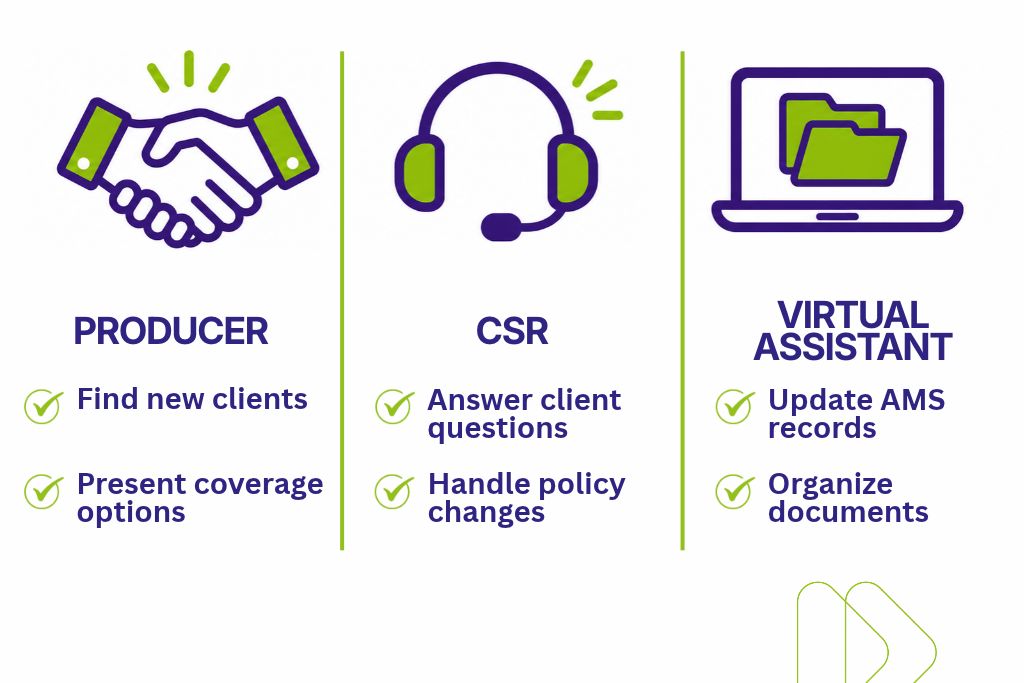
Producers should be spending most of their time prospecting, doing coverage reviews, putting proposals together, working with underwriters on harder-to-place accounts, and staying in touch with your largest clients.
Certificates, loss run requests, AMS data entry, and scheduling still need to get done, but a producer doesn’t need to be the one doing them. When a six-figure producer spends two hours a day on admin, you’re paying a sales salary for support work, and losing hours that could have gone toward new business.
CSRs: Service and Retention
CSRs and account managers handle coverage questions, endorsements, renewals, and certificates with unusual requirements. They’re often the person your clients know best, and a lot of what they do takes a license and years of experience.
Many CSRs also spend a good chunk of each day indexing documents, sorting through email, and updating the CRM. Every hour that goes to those tasks is an hour they aren’t on the phone with clients, and response times get longer as a result.
Virtual Assistants: Support for Both
A specialized insurance VA takes on the repetitive, process-based work that producers and CSRs are currently fitting in around everything else. That usually includes:
- AMS data entry and document indexing
- Renewal prep and loss run requests
- Building submissions for producer or CSR review
- Standard certificates from approved templates
- Carrier follow-up on outstanding items
- Inbox and calendar management
Drawing the Line
When you’re deciding who should own a task, ask whether it needs a license or a judgment call. If it does, it stays with a producer or CSR. If it doesn’t, a VA can usually handle it.
Take certificates. A standard COI for a holder you send one to every year can be done from an approved template, so a VA can turn it around quickly. If the request involves adding an additional insured or specific waiver language, the CSR should handle it, since someone needs to read the policy and possibly work with the carrier.
Renewals can be split up in a similar way. Your VA pulls the expiring policy, requests loss runs, and builds the file. The CSR reviews it and talks with the producer about whether to remarket. The producer meets with the client. Any conversation about coverage stays with licensed staff.
What You Gain
Once the work is divided this way, producers get more selling time back and CSRs can respond to clients sooner. You also spend less of your own week filling gaps. A trained insurance VA adds that capacity without the cost and long hiring process that comes with another local employee.
A Simple First Step
Look back at what your producers and CSRs worked on last week and mark anything that didn’t need a license or a judgment call. That list will give you a good idea of what a VA could take over first.
If you’d like help working through it, schedule a consultation with Remote Insurance Team. We’ll look at your current workflows with you and talk through where a trained insurance virtual assistant would help most.